Every payment system has to answer one question first: when has the money actually moved? On eCurrency, the first confirmation arrives in 10 seconds. That number is the block interval, and it sets how the network behaves under real payment load.
Every 10 seconds the network produces a block. A transaction included in that block has its first confirmation, which is the network acknowledging it and fixing its place in the ledger. For a lot of everyday payments, that first confirmation is enough to act on. For larger transfers, you wait for a few more blocks, and the reason why is worth understanding.
How certainty accumulates
Bitcoin established that you can settle value between strangers with no central operator, and it does this through proof of work, where your confidence in a payment grows with each confirmation that stacks on top of it. eCurrency keeps that idea and swaps proof of work for proof of stake.
There is no hash lottery on eCurrency. Each block carries a stake weight derived from the value and age of the UTXOs backing it, and the canonical chain is the branch with the greatest cumulative stake weight. Ordering is deterministic. Two competing blocks at the same height do not start a guessing game about which one will win, because the rule that decides is fixed and economic.
Settlement confidence then grows with depth. To rewrite the last few blocks, an attacker has to out-weigh the honest chain across all of them, and the cost of doing that climbs sharply as the history gets deeper. A small payment and a six-figure settlement do not need the same number of confirmations. The merchant or the settlement desk picks a depth that matches the value at risk, which is the same judgment call retail and banking already make today.
Why not 3 seconds
Shorter blocks come with a cost that is easy to miss. Every block needs time to reach validators across the network before the next one is due. Push the interval down to 3 seconds and that propagation window tightens, competing blocks at the same height become more common, and keeping up requires heavier validator hardware. eCurrency is built to keep validation reachable on moderate hardware, so it does not chase sub-second blocks.
Why not 30 seconds
Slow the interval to 30 seconds and you spend responsiveness you cannot get back. The first confirmation is the moment a shopper at a terminal, or a desk closing a batch, is waiting on, and half a minute of waiting is too long for that step. Ten seconds sits in the workable middle. It is short enough that the first confirmation feels prompt, and long enough to give validators on ordinary machines time to receive and check blocks before the next one is due.
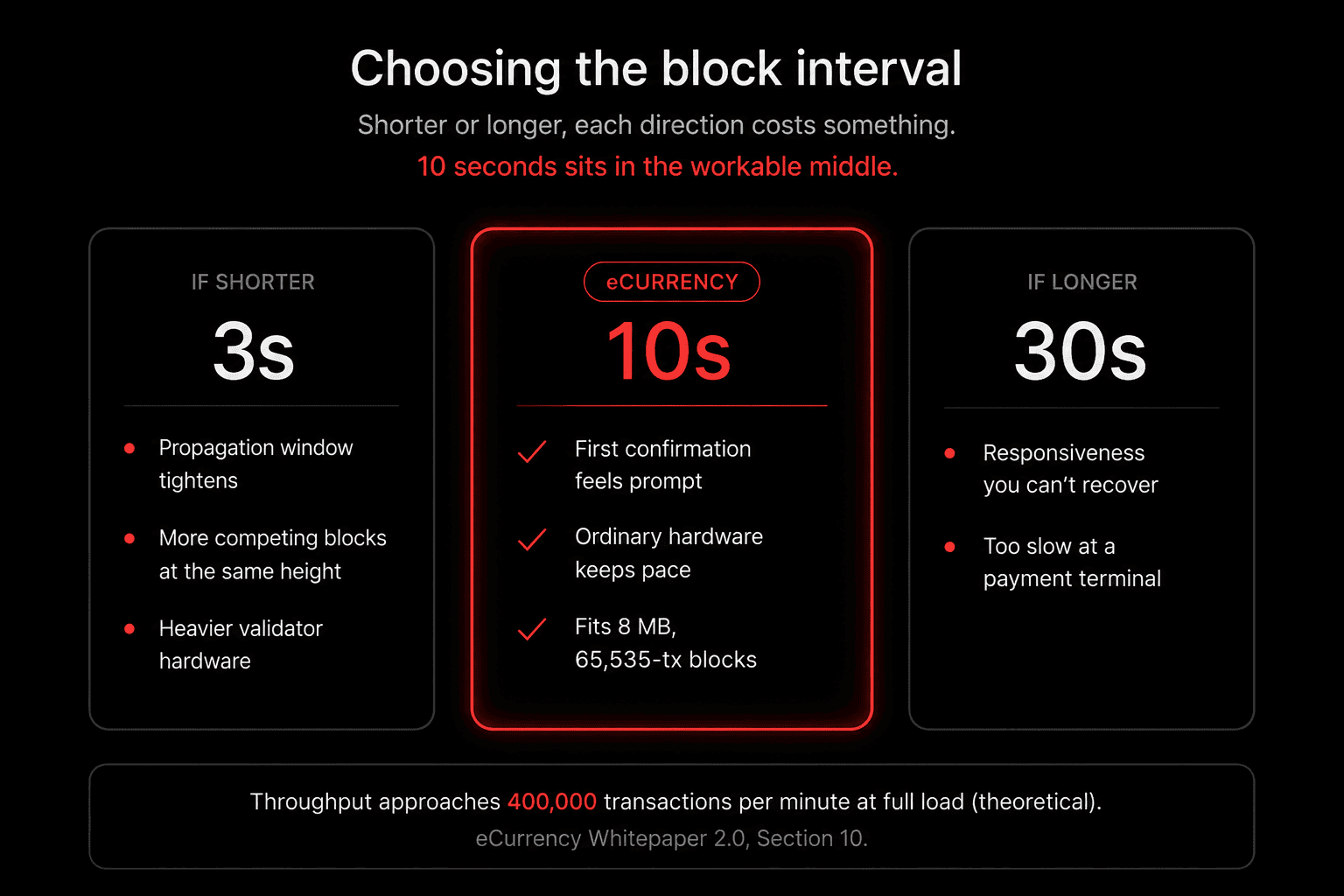
Ten seconds is the interval that keeps that balance: fast enough that the first confirmation feels immediate, and slow enough that validators on ordinary hardware can keep up without a hardware arms race. Confidence in a transaction then builds with each block on top of it, so the confirmation depth you wait for can match the size of what's moving, rather than a single fixed rule for every payment.
Reference: eCurrency Whitepaper