Quantum computers and current cryptography: what to expect
Your Bitcoin address, your Ethereum private key, and your bank's authentication code are all protected by elliptic curve cryptography. This system has worked for decades. It's mathematically elegant and computationally secure, but that changes once a quantum computer arrives.
A sufficiently powerful quantum computer could solve the discrete logarithm problem that protects these systems. The timeline is uncertain, but the cryptographic risk is real enough that governments and researchers are investing now.
Here's how it works. Traditional computers use bits: 0 or 1. Quantum computers use qubits, which can be both 0 and 1 simultaneously. This property, called superposition, lets quantum computers explore many solutions in parallel. Shor's algorithm, discovered in 1994, provides the theoretical method. A quantum computer running Shor's algorithm could derive a private key from its public counterpart, which is exactly what protects Bitcoin, Ethereum, and most blockchains today.
Research in quantum hardware has moved fast, with real experimental milestones in quantum error correction and competing architectures like superconducting qubits and neutral atoms. Scaling to cryptographically relevant machines still has many unsolved problems, and expert estimates for when quantum computers could threaten Bitcoin vary widely. That uncertainty is the reason to plan early.
The risk is what cryptographers call “harvest now, decrypt later.” An attacker could record encrypted transactions today and decrypt them once quantum computers arrive. For a crypto asset like Bitcoin, this means old transactions could eventually become readable if the keys protecting them are still exposed. For individuals holding coins in addresses they haven't moved, this could mean exposure.
Post-quantum cryptography solves this with different math. Most schemes rely on lattice problems or coding theory, which resist both classical and quantum attacks; elliptic curves do not.
Why migration is hard
If the problem is known, why haven't all blockchains migrated already?
The answer is coordination, and it matters because rushing the fix can create new risks. Blockchains are decentralized networks run by thousands of independent validators. Changing the signature scheme is a consensus change that touches every address, every key, every wallet.
Here's what migration looks like in practice. To upgrade to post-quantum signatures, a network must:
-
Reissue addresses. Old addresses using elliptic curve keys won't work with a new signature scheme. Holders must migrate coins from old addresses to new quantum-resistant ones. Every coin holder needs to act. If someone is inactive or has lost their keys, their coins become inaccessible.
-
Maintain backward compatibility during transition. Validators must support both old and new signature types for a period. This adds complexity to code and consensus rules. The longer the transition, the longer the network carries that complexity. But rushing it increases the chance of bugs.
-
Maintain backward compatibility during transition. Validators must support both old and new signature types for a period. This adds complexity to code and consensus rules. The longer the transition, the longer the network carries that complexity. But rushing it increases the chance of bugs.
-
Coordinate globally. Miners, exchanges, wallet providers, and holders all need to upgrade software at roughly the same time. A single exchange or large holder that doesn't upgrade can create orphaned coins or forks. Coordinating millions is difficult, even with clear incentives.
Bitcoin has started discussing this problem seriously. A post-quantum Bitcoin would likely require a gradual migration that could take years. Ethereum would face similar challenges. The deeper issue is that existing coin holders have already made an implicit bet on the current system. Asking them to migrate is friction. Some will lose coins to mistakes or lost keys. Some won't participate.
For a network launched before the quantum threat was widely understood, migration is a necessary upgrade. The longer a network has used elliptic curve keys, the harder the transition. But it's also why the transition must be careful. The risk from implementation bugs or coordination failure could be worse than the quantum risk itself if done hastily.
eCurrency's approach: post-quantum signatures with Falcon
eCurrency operates under different constraints.
The network launched in 2018 and underwent a full architectural redesign in 2025. That redesign added post-quantum signatures as an option alongside eCurrency's existing classical signature schemes.
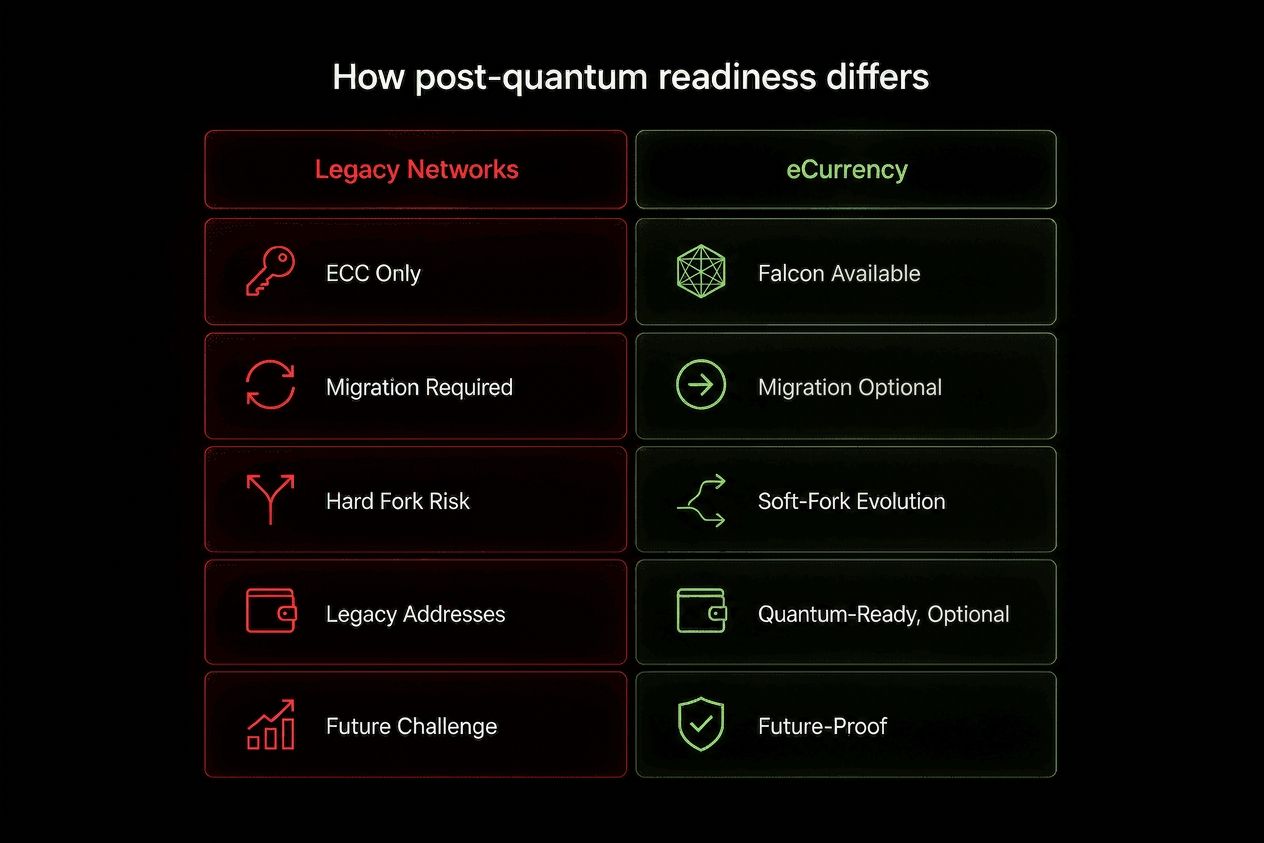 eCurrency supports Falcon, a lattice-based signature scheme NIST selected for post-quantum standardization, alongside its classical signing options. Falcon keeps signature size and verification speed practical for a payments-focused blockchain.
eCurrency added post-quantum addresses as a built-in option during the 2025 redesign. This means:
- Post-quantum addresses, available now, not required. Holders can create Falcon-based addresses today. Classical addresses continue to work, and nobody is forced to move before they're ready.
- No hard fork needed to offer the option. Because eCurrency was designed to support multiple signature schemes from the start, adding post-quantum addresses came through a soft fork rather than the network-wide coordination event a hard fork would require.
- No forced deadline. Moving to a post-quantum address is a holder's choice, on their own timeline, not a network-wide cutover.
This is the advantage of building a new blockchain when the quantum threat is already understood. You can make structural choices that older networks cannot easily undo. Bitcoin and Ethereum were designed in a different era. They inherited strong engineering for their time. But they are constrained by a cryptographic standard that will eventually require careful, coordinated effort to replace.
eCurrency is different: a fixed-supply blockchain built for digital payments, with post-quantum protection available from day one instead of years down the road. Holders who want it can move to a Falcon-based address whenever they choose. That flexibility is what makes it relevant to institutions managing long-term holdings.
Learn more about technology behind eCurrency.