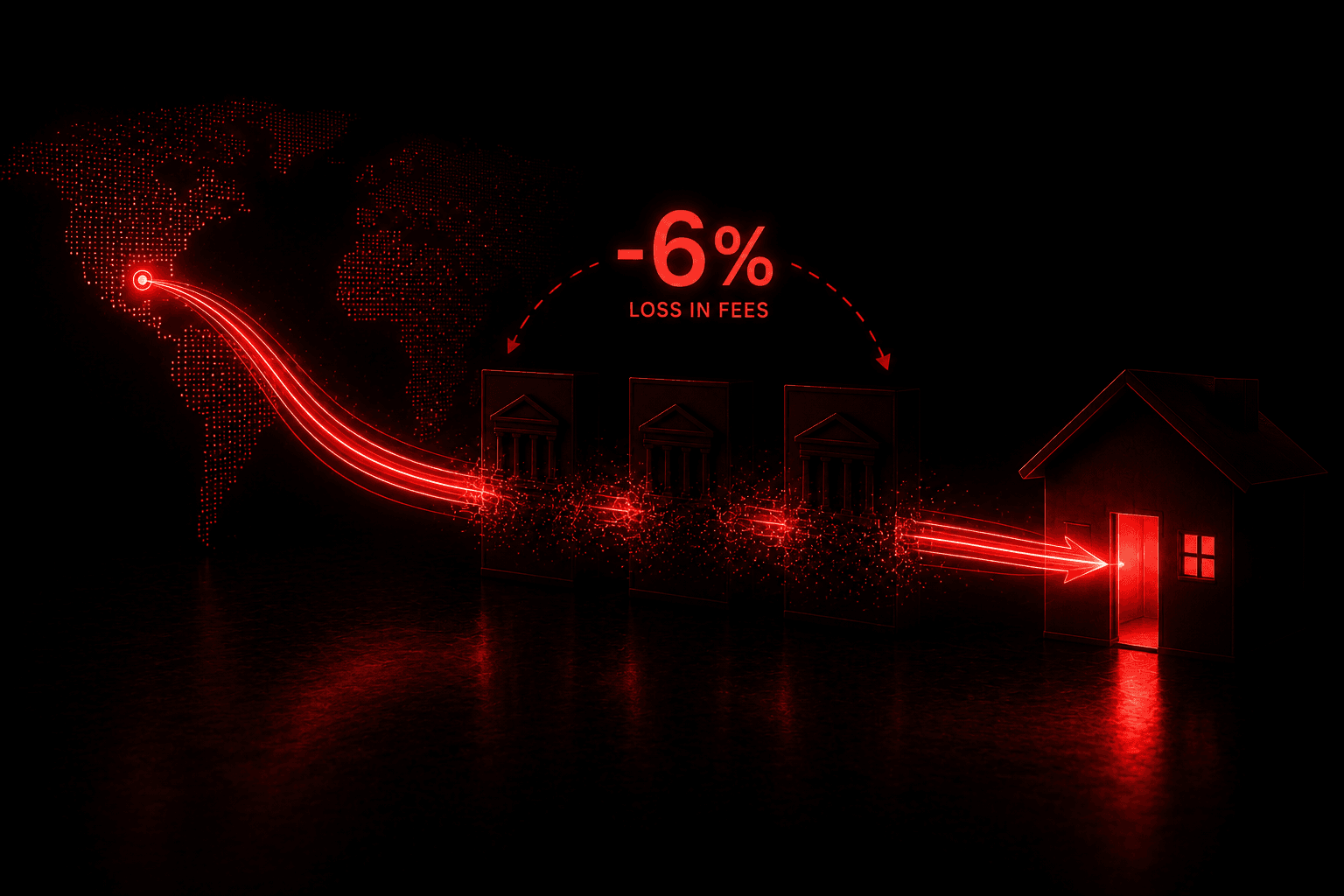
Sending $1,000 across a border sounds simple. You give your bank the money, they send it to the other side, and the recipient gets it. Reality is a bit more complex.
If you're sending that $1,000 from the US to family in the Philippines, you'll lose somewhere between $60 and $80 before it arrives. That's 6 to 8% gone to fees, currency markups, and intermediary charges. For remittances to low-income countries, the average sits at 6.36% per the World Bank's Remittance Prices Worldwide — a figure that has barely budged in years.
The cost isn't the only problem. The time is.
That $1,000 doesn't arrive in hours. It arrives in 3 to 5 business days, sometimes longer depending on which banks are involved and what time of day you send it. The recipient can't rely on having it when they need it. Your working capital is tied up in transit. If you're a small business doing international payroll or paying an overseas vendor, this matters.
The system works this way because moving money across borders isn't a simple transfer. It's a chain of intermediaries, each taking a cut.
The cost breakdown
Here's what happens inside that 6%.
When you send $1,000 to another country, your bank doesn't send your money directly to the recipient's bank. It goes through a network of correspondent banks. Your bank has a relationship with a correspondent bank in a regional hub, which in turn has a relationship with another correspondent bank, which ultimately connects to the recipient's bank. Each one takes a fee.
On top of the wire transfer fees themselves, there's the currency conversion. Your bank quotes you an exchange rate that's not the real market rate. It's marked up by 1 to 5%. That's pure spread for the bank. Then the recipient's bank does the same thing on the other end. By the time the money lands, it's been converted twice through markups at each step.
These aren't small charges that add up to nothing. For a $500,000 international payment, even a 0.1% fee is $500. Cross-border B2B payment volume runs into the tens of trillions of dollars annually, and at typical rates of 2 to 7%, that adds up to tens of billions of dollars in costs each year — costs that don't buy anything or move anything faster.
Why does it take days?
The time delay compounds the cost problem.
When your bank initiates a SWIFT wire (the global standard for international bank transfers), it's sending a message through a network built in the 1970s and upgraded piecemeal ever since. The message travels. It waits for processing windows. If it arrives outside business hours in the destination country, it waits until business hours resume. If there's a holiday, it waits for the next business day. Currency conversions have their own settlement cycles. The recipient's bank then needs to confirm it received the money, reconcile it against its internal ledgers, and credit the account.
Even under Swift's newest global payments framework, only about three in four transfers reach the destination bank within ten minutes, and full modernization is still rolling out corridor by corridor. Outside the upgraded routes, the practical reality remains 2 to 5 business days for most transfers, and longer if anything goes wrong.
For businesses, this creates a real problem: working capital is stranded in transit. If you're a manufacturer in Vietnam and you just paid a supplier in Germany, that money won't be back in your account for days. You can't use it, can't rely on it being there, can't forecast with certainty when you'll have access to funds. You might need to keep extra cash on hand just to account for the float.
For individuals sending remittances, the delay is a different kind of problem. If your family needs money urgently, you can't guarantee it will be there when they need it. The cost hits harder too, because you're often not sending large sums. A $500 remittance with a 6% fee means you sent $470 worth of value. The recipient gets the full $500, but $30 of your money vanished into fees and markups.
What blockchain promised
Blockchain technology emerged with a straightforward promise: remove the intermediaries. Move money peer-to-peer, with no correspondent banks taking cuts, no SWIFT network processing delays, and no currency conversion running through multiple banks along the way. You send the payment, the network confirms it, and the recipient has it in minutes, at a fraction of the cost. The promise made sense. The execution is where things broke down.
Why most blockchains didn't solve this
Bitcoin was the first blockchain, and it proved decentralized digital money could work. It was built to be a store of value, with transactions that are slow and expensive to reverse by design, tuned around a 10-minute confirmation time. That's ideal for locking in something you want to hold forever. It's a poor fit for everyday payments, where you need certainty in minutes and predictable low fees.
Ethereum and other general-purpose blockchains followed, designed for running any kind of program on top of them. That flexibility is powerful, but it creates a problem for payments: to run anything on the network, you need to pay a fee that fluctuates with demand. When the network is busy, the fee spikes. You don't know what you're paying until after the transaction is confirmed. If you're a business processing customer payments, uncertainty is expensive. You can't confidently quote a price.
Ethereum's answer to programmability is the smart contract: code that lives on the blockchain itself, gets stored on the network, and runs on every validator. That's genuinely useful for building complex applications, but for a simple payment it's architectural overkill — you're paying to execute and secure logic you don't need. Bitcoin doesn't carry that particular cost, but it inherits the confirmation-time and reversal-cost limits described above.
So blockchain technology existed, but it wasn't specifically designed for the cross-border payment problem. It was designed for other things, and payments were an afterthought.
What purpose-built payment infrastructure looks like
The question isn't whether blockchain can solve cross-border payments. It's what happens when you design a blockchain specifically for that problem rather than adapting a general-purpose network.
Purpose-built infrastructure makes different choices
Heavy logic can run on the client side — the sender's device or their bank's system — while the chain itself stays lightweight: it verifies the transaction and settles it, without every validator having to execute and store application code. That keeps the base layer fast and cheap. You send the payment, the network confirms it within seconds, and settlement confidence builds with each additional block that passes.
Validator compensation can also be designed to stay stable rather than tracking transaction volume directly. Rather than validators depending purely on a fee that spikes when the network gets busy, a dedicated reward pool can smooth their income across quiet periods and busy ones alike.
A 10-second block interval means transactions confirm quickly, quick enough that working capital isn't meaningfully tied up in transit.
The fixed supply means no inflation eroding the value between when you send and when the recipient receives. If you send a dollar's worth of value, they get a dollar's worth.
Because it's designed from the ground up for payments, the architecture is focused on one goal: moving value across borders quickly, cheaply, and reliably.
The design matters
The 6% cost and 3 to 5 day settlement time aren't bugs in the current system. They're features of the architecture. Correspondent banking networks require intermediaries because they settle through the traditional banking system. SWIFT requires processing time because it was designed for a different era. Currency conversions require multiple exchange points because each intermediary needs to profit.
None of that changes unless the infrastructure changes. Blockchain can change it. Most blockchains haven't, because they weren't built for this problem.
The ones that were built for payments from the very beginning operate under fundamentally different economics and timing. Settlement happens in seconds and costs fractions of a percent, without the days-long float or layered fees of the correspondent system.
That difference compounds. For an individual sending remittances, it means more money reaches the family. For a business making international payments, it means better cash flow and no working capital tied up in transit. For the global economy, it means billions of dollars in transaction costs can be reduced closer to zero.
The problem is real. The solution exists. It just has to be built specifically for this, and for this alone. Learn more about how eCurrency is built here.