Who Remittances Support
Remittances support a huge share of the world's population. According to United Nations estimates, roughly one in nine people globally receives money sent by a relative working in another country, and most of that money covers essentials: food, school fees, medical costs, housing. For a lot of households, it's the difference between managing and not.
The person sending that money is usually a migrant worker, often earning modest wages abroad, setting aside a portion of each paycheck to send home every month or two. The fee taken out of that transfer is real money that a family doesn't receive.
What 6% Costs in Real Terms
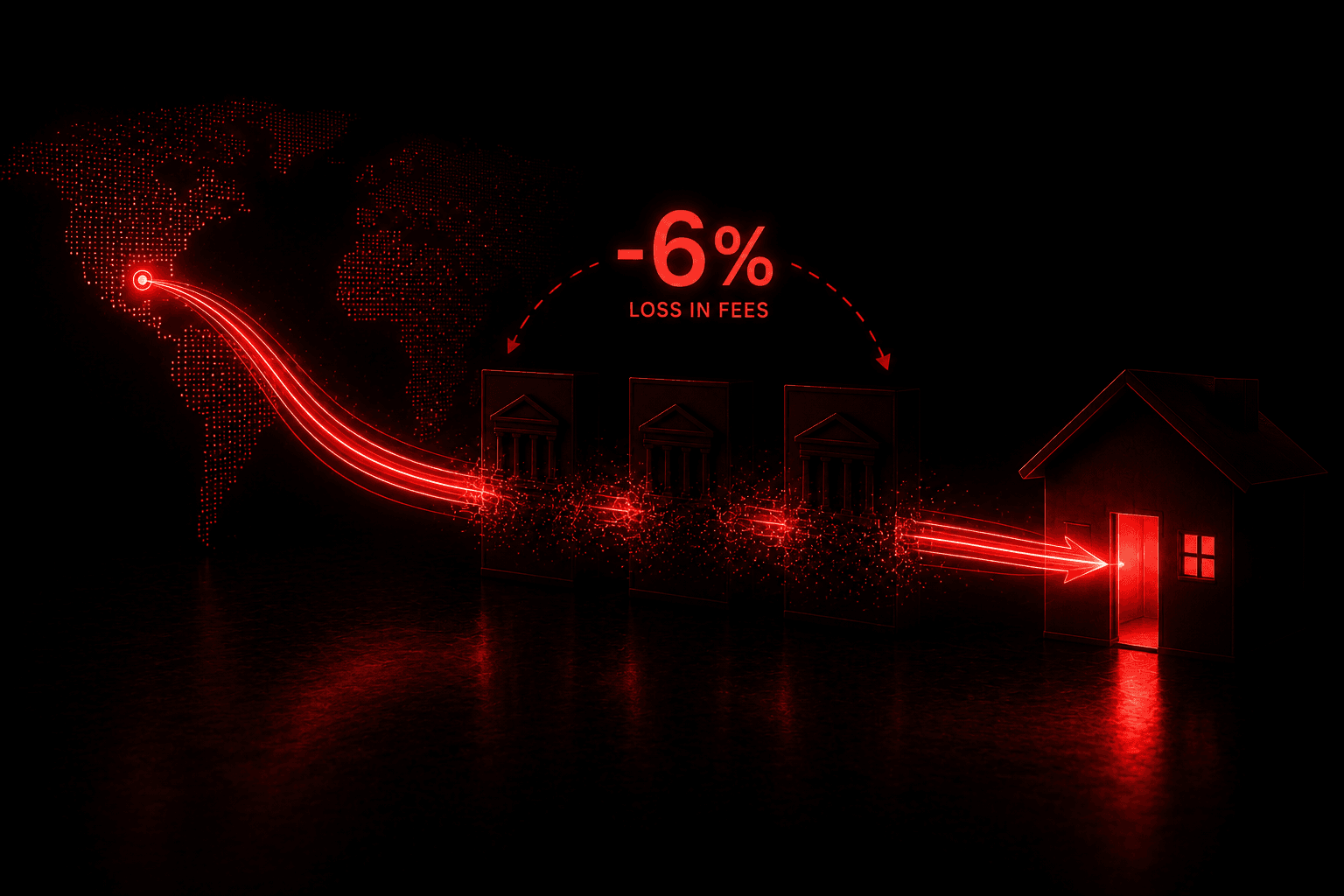
The World Bank's most recent Remittance Prices Worldwide report put the global average cost of sending a remittance at 6.36% as of the third quarter of 2025. On a $200 transfer, a common amount for a single remittance, that's over $12 gone before the money arrives. Send that same $200 every month for a year, and the fees add up to about $153 lost to intermediaries, close to three-quarters of a single month's remittance.
Some corridors are worse than others. Costs tend to be highest precisely where remittances matter most: low-income countries and regions with less competition among money transfer providers. The United Nations' target of getting this down to 3% by 2030 has existed for years, and progress toward it has been slow.
Why the Cost Is Structural
A remittance rarely moves in one step. It typically passes through a sending institution, one or more correspondent banks, and a receiving institution before it reaches the recipient, and each participant in that chain takes a cut and holds the funds briefly before passing them along. That's also why these transfers commonly take one to several business days to actually clear, on top of the money lost along the way.
We've written already about the technical mechanics of that correspondent banking chain and why it adds both cost and delay. The fee reflects how many intermediaries sit in the corridor between the sender's bank and the recipient's.
What Changes With Direct Settlement
Removing intermediary hops changes the economics as well as the speed. When value moves directly between two parties, there's no accumulating series of cuts taken along the way, the kind that builds up when a chain of correspondent banks each takes a share. eCurrency's protocol is designed to confirm a transaction within 10 seconds, the interval at which the network adds a new block, with settlement confidence building further as additional blocks confirm on top.
Blockchain settlement doesn't solve remittances end-to-end. Getting funds into and out of local currency still involves an off-ramp, and that leg carries its own costs and regulatory requirements that a settlement layer alone doesn't remove. Direct settlement addresses the specific cost and delay created by a chain of correspondent banks, a real and substantial part of today's 6.36% average.
Why This Matters Beyond the Numbers
For the roughly 800 million people receiving remittances, that 6.36% is rent, a school fee paid on time, a medical bill covered before it becomes a crisis. Infrastructure that removes even part of the cost sitting in that chain makes a meaningful difference for a lot of families, one that shows up at the end of the month.
Sources World Bank, Remittance Prices Worldwide, Issue 54 (Q3 2025) United Nations DESA, “Remittances matter”